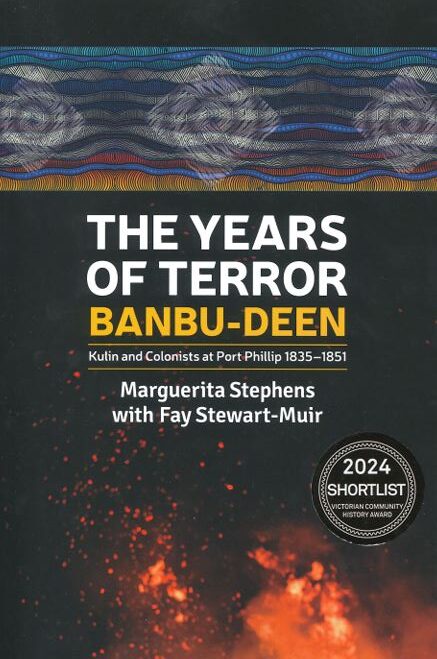
The Years of Terror: Banbu-Deen – Kulin and Colonists at Port Phillip 1835-1851 by Marguerita Stephens with Fay Stewart-Muir

(2 customer reviews)

SHORTLISTED – COLLABORATIVE COMMUNITY HISTORY AWARD, VICTORIAN COMMUNITY HISTORY AWARDS 2024

Why did Billibellary and other Wurundjeri and Boonwurrung clansmen and women parley with Batman on the banks of the Merri Creek in June 1835?  And what befell the clans in the decade and a half that followed that fateful encounter with Britain’s Empire? Based primarily on the daily journal of Assistant Protector William Thomas, this work meticulously documents the lives, and deaths, of those who struggled to hold their Country as La Trobe unleashed ‘the terror of British law’ on them. Both defender of Kulin rights and agent of empire, Thomas was a unique witness to the devastation of the Kulin, recording their heartbreak and defiance as they succumbed to disease and hunger. The Years of Terror: Banbu-deen provides a new history of colonisation at Port Phillip, bringing the focus to bear on those who were violently dispossessed of lands and waters, theirs from time immemorial.

‘This book is a remarkable achievement that makes William Thomas’ voluminous work even more accessible. It offers a rich portrait of those harrowing years after invasion – those ‘years of terror’. The chapters are brimming with details, characters and insights. They have the feel of the journals, yet flow so much more freely and help elucidate the complexities of Thomas and his interactions with the peoples of the Kulin Nation. It is a book that will reward re-reading and will become an invaluable resource for years to come.’ Dr Billy Griffiths

PB 498pp, 2023

ISBN 9781922669841

$59.95

Out of stock

Book Reviews 2 reviews for The Years of Terror: Banbu-Deen – Kulin and Colonists at Port Phillip 1835-1851 by Marguerita Stephens with Fay Stewart-Muir

  1. Allen

    Just attended a Q&A with Aunty Fay Stewart-Muir and Marguerita Stephens as part of the Brimbank Writers and Readers Festival 2026. This book was only made possible due to beautiful partnership and bond shared between the authors, the many back and forth were all done through emails. I can’t imagine how challenging it would have been for both of them, especially Aunty Fay to read about how her people were insulted and massacred in William Thomas’s journal. It is sad that Aboriginal people of today can only learn about their people history from the perspective of their oppressors. To think that Marg had to put her foot down and demand to the publishers to include Aunty Fay’s name on the cover is a sign that we have a long way to go to become an equal society and this book is more relevant than ever despite the period described was nearly 200 years ago.

    Their partnership is such a great example of moving away from eurocentrism and hopefully a blueprint for future collaborations in sharing Australian history. Sometimes the quietest of voices have the most important things to say and I found myself at the edge of my seat throughout the duration of this presentation to catch every word spoken with such intention by the authors. The first thing they pointed out was the lack of women perspective as the archive was from a white male writing about Aboriginal male, so we lost half of the population’s input in the 19th century, which is a shame.

    I also noticed the subtle things that Marguerita did at the start of every question, she would often pause and allow Aunty Fay space to speak first or checking if Aunty Fay has anything to add. One of the question from Uncle Shane Charles was something about how can Aboriginal/ Australia history be told in the rightful, balanced manner by the white Australians, also part of the same group that caused the harm. Marg shared a bit about her experience of going to Ringwood High in the 1960s where racism was the norm, she spoke about the importance of decentralising one self when reading the archives of William Thomas’s journal or any form of painful history of Australia. I thought that is a good idea for white people to decentralise one self, to leave space to understand, acknowledge and learn what actually happened in Australia without the feeling of defensive, white guilt.

    Both authors agree that, although painful, we can’t run away from the words genocide or massacre when talking about Australia history. And we shouldn’t. It is high time everyone learn what really happened here. Not to pass blame or sow seeds of division/ hate, if we can learn anything from this book is clearly the collaboration between 2 women from very different cultures, 2 cultures that used to be at war here on this land now call Australia, and yet they choose to prioritise their labour of love, art, truth telling which made this book possible.

  2. Tom Maher

    A detailed and disturbing history of the people around and south of Melbourne from its establishment in the 1830s until the 1850s from the diaries of William Thomas and other contemporary sources. For an area that has no large ‘massacres’ recorded, the mistreatment, dispossession and subjugation of the native tribes is stark – enabling starvation, disease, birth reduction, violence and incarceration to proliferate. The account also gives insight into the culture, intelligence, land management, laws, organisation, and beliefs of the persecuted. The book should be recommended to current Victorian inhabitants, especially in Melbourne and the Mornington Penninsula through libraries and schools.

Add a review

Your email address will not be published. Required fields are marked *

Description

SHORTLISTED – COLLABORATIVE COMMUNITY HISTORY AWARD, VICTORIAN COMMUNITY HISTORY AWARDS 2024

Why did Billibellary and other Wurundjeri and Boonwurrung clansmen and women parley with Batman on the banks of the Merri Creek in June 1835?  And what befell the clans in the decade and a half that followed that fateful encounter with Britain’s Empire? Based primarily on the daily journal of Assistant Protector William Thomas, this work meticulously documents the lives, and deaths, of those who struggled to hold their Country as La Trobe unleashed ‘the terror of British law’ on them. Both defender of Kulin rights and agent of empire, Thomas was a unique witness to the devastation of the Kulin, recording their heartbreak and defiance as they succumbed to disease and hunger. The Years of Terror: Banbu-deen provides a new history of colonisation at Port Phillip, bringing the focus to bear on those who were violently dispossessed of lands and waters, theirs from time immemorial.

‘This book is a remarkable achievement that makes William Thomas’ voluminous work even more accessible. It offers a rich portrait of those harrowing years after invasion – those ‘years of terror’. The chapters are brimming with details, characters and insights. They have the feel of the journals, yet flow so much more freely and help elucidate the complexities of Thomas and his interactions with the peoples of the Kulin Nation. It is a book that will reward re-reading and will become an invaluable resource for years to come.’ Dr Billy Griffiths

PB 498pp, 2023

ISBN 9781922669841

Additional information

Weight 0.850 kg
Dimensions 22.5 × 15 × 3 cm

Book Reviews 2 reviews for The Years of Terror: Banbu-Deen – Kulin and Colonists at Port Phillip 1835-1851 by Marguerita Stephens with Fay Stewart-Muir

  1. Allen

    Just attended a Q&A with Aunty Fay Stewart-Muir and Marguerita Stephens as part of the Brimbank Writers and Readers Festival 2026. This book was only made possible due to beautiful partnership and bond shared between the authors, the many back and forth were all done through emails. I can’t imagine how challenging it would have been for both of them, especially Aunty Fay to read about how her people were insulted and massacred in William Thomas’s journal. It is sad that Aboriginal people of today can only learn about their people history from the perspective of their oppressors. To think that Marg had to put her foot down and demand to the publishers to include Aunty Fay’s name on the cover is a sign that we have a long way to go to become an equal society and this book is more relevant than ever despite the period described was nearly 200 years ago.

    Their partnership is such a great example of moving away from eurocentrism and hopefully a blueprint for future collaborations in sharing Australian history. Sometimes the quietest of voices have the most important things to say and I found myself at the edge of my seat throughout the duration of this presentation to catch every word spoken with such intention by the authors. The first thing they pointed out was the lack of women perspective as the archive was from a white male writing about Aboriginal male, so we lost half of the population’s input in the 19th century, which is a shame.

    I also noticed the subtle things that Marguerita did at the start of every question, she would often pause and allow Aunty Fay space to speak first or checking if Aunty Fay has anything to add. One of the question from Uncle Shane Charles was something about how can Aboriginal/ Australia history be told in the rightful, balanced manner by the white Australians, also part of the same group that caused the harm. Marg shared a bit about her experience of going to Ringwood High in the 1960s where racism was the norm, she spoke about the importance of decentralising one self when reading the archives of William Thomas’s journal or any form of painful history of Australia. I thought that is a good idea for white people to decentralise one self, to leave space to understand, acknowledge and learn what actually happened in Australia without the feeling of defensive, white guilt.

    Both authors agree that, although painful, we can’t run away from the words genocide or massacre when talking about Australia history. And we shouldn’t. It is high time everyone learn what really happened here. Not to pass blame or sow seeds of division/ hate, if we can learn anything from this book is clearly the collaboration between 2 women from very different cultures, 2 cultures that used to be at war here on this land now call Australia, and yet they choose to prioritise their labour of love, art, truth telling which made this book possible.

  2. Tom Maher

    A detailed and disturbing history of the people around and south of Melbourne from its establishment in the 1830s until the 1850s from the diaries of William Thomas and other contemporary sources. For an area that has no large ‘massacres’ recorded, the mistreatment, dispossession and subjugation of the native tribes is stark – enabling starvation, disease, birth reduction, violence and incarceration to proliferate. The account also gives insight into the culture, intelligence, land management, laws, organisation, and beliefs of the persecuted. The book should be recommended to current Victorian inhabitants, especially in Melbourne and the Mornington Penninsula through libraries and schools.

Add a review

Your email address will not be published. Required fields are marked *

Shop All Categories