
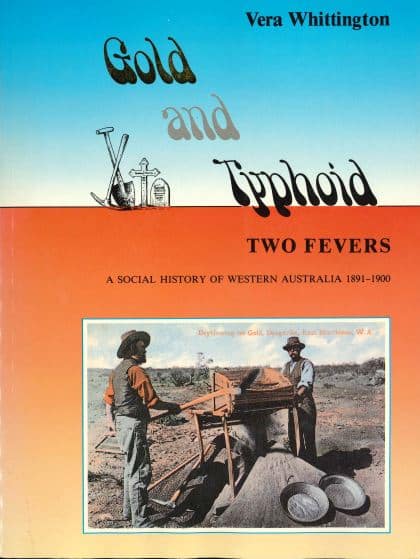
Description
SECONDHAND BOOK
The major themes, gold fever and typhoid fever, as related to each other haven’t previously been researched. Celebration and grief, wealth and poverty existed side by side as Western Australia, recently granted Responsible Government, wrestled with the multitudinous problems and logistics of coping with hordes of gold diggers. Its capital, Perth, was little more than a small town, with inadequate drainage, sanitation and housing. Gold rushes occurred six to seven hundred and more kilometres away, in dry regions hitherto uninhabited by Europeans. Water was the essential but scarce and costly commodity needed to maintain the miners and the hundreds of horses and camels used for transport. The Government was faced with providing water supplies, roads, railways, post offices, police stations, schools and hospital accommodation (which until then had been minimal), as well as establishing towns and supporting local government. With the unprecedented growth, services were urgently required in every area. Provision fell behind demand. The thrust of development came from one sensational gold find after another, but life-threatening water famines and endemic typhoid (an estimated 16,000 cases) followed in their wake. A reasonable equilibrium in the life-or-death struggle against typhoid had been achieved by the end of the century but stabilization of life on the eastern goldfields came only with the completion of the Coolgardie Water Scheme.
Specifications:
Condition: Good, minor wear
Publisher: University of Western Australia Press
Year: 1988
Format: Paperback
Pages: 455pp
ISBN: 9780855642754
























 239 A'Beckett Street Melbourne, Victoria, 3000
  03 9326 9288
  office@historyvictoria.org.au
  Office & Library: Weekdays 9am-5pm


Book Reviews Reviews
There are no reviews yet.