
Attractive neighbourhoods or Hong Kong without the view?
July 2025
The Victorian Government has recently introduced a series of amendments to the planning controls that determines what can be built where, with the aim of addressing the current housing crisis by facilitating permits and increasing the availability of affordable housing. There have been a bewildering series of public announcements by the government about complex and controversial changes, which have raised concerns about the impact they will have on local neighborhoods and on the heritage values that make Melbourne such an attractive and liveable city.
These changes focus on the development of what the government is calling Activity Centres. These are areas around train and tram stations that are designed to accommodate more residents, businesses, and services. Ten such centres have been identified so far – at Broadmeadows, Camberwell Junction, Chadstone, Epping, Frankston, Moorabbin, Niddrie, North Essendon, Preston, Ringwood. There are plans to eventually have sixty such Activity Centres in the Melbourne metropolitan area and regional centres.
Surrounding each Activity Centre is a catchment zone, a zone that is within approximately 10 minutes’ walking distance, or 800 metres, from the Activity Centre’s core. Allowable building heights are at their highest in the core of the Activity Centre and decrease as you move outwards into the catchment zones. In the centre itself, from 4 to 20 storeys buildings are allowed. In the catchment zone, up to six storey apartments are allowed, or up to eight storeys if the Minister judges the building to be a ‘great design’.
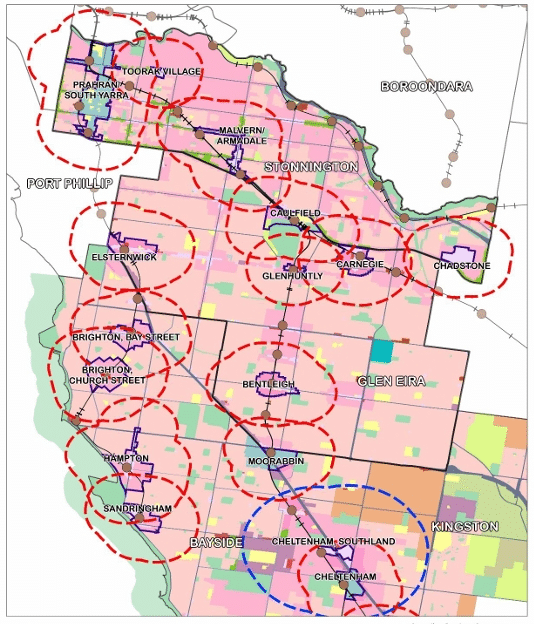
It was originally assumed that the 800 metres that defined the catchment zone would be measured from the middle of the Activity Centres. However, it turns out that the boundaries of the catchment zones are to be measured from the periphery of the Activity Centre, not its middle, making them much larger than expected. Mapping these catchment zones around the already designated Activity Centres shows that they overlap with one another and that as a result over half of the existing residential areas in southeastern Melbourne would be swallowed up by these new zones, within which six to eight story buildings are allowed, and even encouraged.
These zones were originally referred to by the government as ‘Walkable Catchment Zones’, referring to the fact that they were within 10 minutes walking distance from a train station. But with this new definition of them as measured from the periphery, the name has been changes to ‘Housing Choice and Transport Zones’.
The RHSV’s concern is that this new zoning scheme is aimed at providing more housing, and that heritage protection is likely to be given low priority. The government has said that under the new rules heritage will be looked after, stating that:
There will be no changes to heritage overlays or amendments to local or state planning policies relating to heritage as part of the Activity Centres Program. New buildings will still have to follow existing heritage controls, as well as relevant state and local policy.
However, RHSV believes that this is misleading. Decision makers will be weighing the protection of heritage and neighbourhood character against the urgent need to provide more housing, and in this process heritage protection is likely to take second place.
The RHSV recognises the need for and supports increased housing in our suburbs to provide for Victoria’s growing population. However, it does not believe that these reforms will unlock the supply of housing. While they may streamline and facilitate the process of obtaining building permits for higher density housing, it does not believe that obtaining permits is a limiting factor on the supply of housing. There are plenty of approvals, a record 127,792 building permits in 2021, but developers are not using them. In 2023 The Age found that there were permits for 118 residential buildings and 22,000 apartments in the CBD where work had not begun. Multi-unit housing approvals consistently have more than met demand. Many thousands of housing approvals have not been acted upon. Thousands more completed apartments remain unsold.
The RHSV supports efforts to build more housing in places where people want to live. But places will become far less sought after if we forget what makes them desirable in the first place. To be attractive and liveable, new housing developments need to preserve the heritage of the area. Some of our best heritage precincts are around railway stations and Activity Centres. These are precincts that contribute in a significant way to what makes Melbourne and Victorian regional centres distinctive and liveable, giving them unique character and appeal. If we destroy heritage, Melbourne will become ‘Hong Kong without the view’, a collection of soulless high-rise buildings. Heritage makes Melbourne marvellous and makes our regional towns and cities attractive as tourist beacons and signposts to our history. Heritage enhances a neighbourhood’s soul and character, and provides focal points and historical perspectives. We need housing and heritage, housing that preserves, respects and is integrated with heritage.

In April this year, the upper house of the Victorian Parliament considered a motion to disallow the planning changes that would implement the new strategy. This led to a Select Committee Inquiry at which more information came to light. The Select Committee had similar concerns to those expressed by the RHSV. It found that:
Little convincing evidence was advanced to the Inquiry that the State Government’s announced planning changes will guarantee additional housing, and no substantive evidence was advanced that the Government’s plan would with certainty provide additional affordable housing.
It also shared the concerns expressed by the RHSV and other organizations about the threats to the heritage value of neighbourhoods:
The Committee acknowledges that the concerns expressed by many submitters that heritage and heritage values are at serious risk of being compromised by these planning amendments are valid. Protections should be available to protect our city and its magnificent buildings and zones.
In the end however the Select Committee did not move to disallow the planning changes, and the government was able to push through its changes. We are now faced with the reality of a new planning system that will put heritage at a severe disadvantage.
What RHSV is calling for
The RHSV supports efforts to build more housing and in particular to build more housing in neighbourhoods close to jobs and transport, including medium- and high-density where appropriate, as near rail stations. For these efforts to succeed, they must produce neighbourhoods that attract people. Heritage is key to success. Preserving heritage and using it as the anchor and focus of redeveloped neighbourhoods is the key to making those neighbourhoods attractive.
The RHSV calls on the state government to implement a major recommendation made by its experts to protect heritage under the new system. The Select Committee advised that the new zone ‘should not be applied to areas that are within a Heritage Overlay or a Neighbourhood Character Overlay’. The RHSV believes that this is the key to ensuring that the new planning system builds neighbourhoods in which people will want to live. It calls on the government to follow its own experts’ advice and remove the new ‘Housing Choice and Transport Zones’ from areas currently under a Heritage Overlay and leave them in a Neighbourhood Residential Zone. This would ensure that the objective of encouraging higher density housing was achieved without the loss of the heritage that makes Melbourne the city we love.
In its letters and submissions to the Minister for Planning and to the Select Committee, the RHSV made a number of more specific recommendations, which can be read by clicking on the links below. Also accessible below are the Minister’s reply, and a joint statement by the National Trust and the RHSV.
To read the RHSV’s April 2025 letter to the Minister for Planning, click here.
To read the Minister’s reply to RHSV of July 2025, click here.
 239 A'Beckett Street Melbourne, Victoria, 3000
  03 9326 9288
  office@historyvictoria.org.au
  Office & Library: Weekdays 10am-4pm

