
The Victorian Community History Awards recognise excellence in historical method: the award categories acknowledge that history can be told in a variety of formats with the aim of reaching and enriching all Victorians. The Victorian Community History Awards have been held since 1999, and are organised by Royal Historical Society of Victoria in partnership with the Public Record Office Victoria.
2023 – 2024 Applications now closed
For history projects which come to fruition between 1 July 2023 and 30 June 2024.
Entries are now closed. The winners of the Victorian Community History Awards 2024 can be viewed here.
2022 – 2023
For history projects which come to fruition between 1 July 2022 and 30 June 2023.
Entries are now closed. The winners of the Victorian Community History Awards 2023 can be viewed here.
2021 – 2022
For history projects which come to fruition between 1 July 2021 and 30 June 2022.
Entries are now closed. The Winners of the Victorian Community History Awards 2022 can be viewed here.
2020 – 2021
The 2021 Victorian Community History Awards cover projects coming to completion during 1 July 2020 and 30 June 2021.
Entries are now closed. The winners of the Victorian Community History Awards can be read here.
2019 – 2020
The 2020 Victorian Community History Awards have closed. The list of 2020 winners and commended entries can be read here.
2018 – 2019
The winners (with Judges’ citations) and commended entries can be found in this booklet.
2017 – 2018
VCHA 2018 winners and commendations booklet
Where to find VCHA publications
Past VCHA Winners
The Victorian Community History Awards were established and sponsored by Information Victoria from 1997 to 2010.
From 2011 the Awards have been administered by the Royal Historical Society of Victoria in partnership with Public Record Office Victoria. The Victorian Community History Awards are held annually to recognise the contributions made by Victorians in the preservation of the State’s history, and to recognise excellence in historical research.
In 2012, following consultation between the Public Record Office Victoria and the Royal Historical Society of Victoria, award categories were slightly altered and renamed, as below:
Victorian Community History Awards 2012
Victorian Community History Awards 2012-2018
Victorian Premier’s History Award (formerly Victorian Community History Award)
- 2021: Ablaze Written and directed by Alec Morgan and Tiriki Onus, produced by Tom Zubrycki, 2021
- 2020: Amanda Scardamaglia for Printed on Stone: The Lithographs of Charles Troedel
- 2019: Phil Roberts for Avenue of Memories
- 2018: Jill Giese for The Maddest Place on Earth
- 2017: John Burch for Returning the Kulkyne
- 2016: Pam Baragwanath & Ken James for These Walls Speak Volumes. A History of Mechanics’ Institutes in Victoria
- 2015: Meredith Fletcher for Jean Galbraith: Writer in a Valley
- 2014: Anne Vale for Exceptional Australian Garden Makers
- 2013: Robin A Vowels for Victoria’s Iron Lacework The Founders, Part A
- 2012: Maree Coote for The Art of being Melbourne
History Publication Award
- 2021: Mike McCarthy for In the Shadow of the Prom: Early South Gippsland times, tales & tramlines
- 2020: Brian Rhule for Maldon: A new History 1853-1928
- 2019 Carolyn Rasmussen for The Blackburns. Private Lives, Public Ambition.
- 2018: Gregory C. Eccleston for Granville Stapylton. Australia Felix 1836. Second in Command to Major Mitchell
- 2017: John Barnes for La Trobe. Traveller, Writer, Governor
- 2016: Rozzi Bazzani for Hector: the Story of Hector Crawford and Crawford Productions
- 2015: Lucy Sussex for Block Buster! Fergus Hume and the Mystery of a Hansom Cab
- 2014: Robert Kenny for Gardens of Fire: an investigative memoir
- 2013: Olwen Ford for Harvester City: The making of multicultural Sunshine 1939–1975
- 2012: Paul Strangio for Neither Power Nor Glory: 100 Years of Political Labor in Victoria, 1856–1956
Special awards
- 2021: R
- 2020: Nick Achen for Visions of Victoria: The Magic of Kodachrome Film, 1950-1975
- 2019: Chloe Hooper for The Arsonist A Mind On Fire
- and also in 2019 David Sornig for Blue Lake Finding Dudley Flats and the West Melbourne Swamp
- 2018: Jennifer Bantow and Ros Lewis for Barro-abil. Our Beautiful Barrabool Stone. History and Use of Barrabool Sandstone.
- 2017: Michael Morrison and Lisa Clausen for Cruden Farm Garden Diaries
- 2016: Magda Szubanski for Reckoning: a Memoir
- 2015: Graeme Davison for Lost Relations: Fortunes of My Family in Australia’s Golden Age
- 2014: Mornington Peninsula Local History Network and Lavender Hill Multimedia for Postcards: Stories from the Mornington Peninsula(DVD)
- 2013: Judges’ Special Prize for Excellence – Rod Charles for A Whirr of Many Wheels. Cycling in Geelong: A chronicle from 1869 to 1980 Volume 1: 1869 to 1914
- 2012: Judges’ Special Prize for Excellence – Lorne Historical Society & Lorne Aireys Inlet P-12 College VCAL Students for Construction of The Great Ocean Road DVD
Local History – Small Publication Award
- 2020: Benjamin Wilkie for Gariwerd: An Environmental History of the Grampians
- 2019 Beris Campbell, Janet Goodwin, heather McKee and editor Helen Penrose with South Melbourne Housing Group Inc for More Than Just Housing: The South Melbourne Community Housing Group Story 1983 – 2018
- 2018: Hans-Wolter von Gruenewaldt and Kay Ball (compiler) for Art Captured. Hans-Wolter von Gruenewaldt Prisoner of War Camp 13 Murchison.
- 2017: Robyn Lewis for Building Castlemaine: The Red Brick Legacy of H.D. McBean
- 2016: Judith Buckrich for The Village of Ripponlea
- 2015: Fiona Poulton and Katherine Sheedy for Boroondara Remembers: Stories of World War One
- 2014: Margaret Bowman for Cultured Colonists: George Alexander Gilbert and His Family, Settlers in Port Phillip
- 2013: Coleen Bower for Water Races and Tin Mines of the Toora District: A Short History of the Tin Mines at Granite Bar and Toora
- 2012: Ken McKimmie for Chewton Then and Now: A series of studies investigating change over time in the former Mount Alexander Goldfield town of Forest Creek later known as Chewton
Local History Project Award
- 2020: Patrick Ferry with Wally Nye Berwick-Pakenham Historical Society & Pakenham RSL, Pakenham 2020 for Blood, Toil Tears & Sweat: Remembering the Pakenham District’s WW2 Service Personnel, 1939-1945
- 2019: Jill A’Vard and Armin Richter Monbulk Historical Society Inc for When Roads Were Tracks; A History of the Roads of Monbulk, Kallista, The Patch and Sherbrooke
- 2018: Elizabeth O’Callaghan for Silent Lives. Women of Warrnambool and District, 1840 – 1910.
- 2017: Collingwood Historical Society for Notable People of Collingwood
- 2016: Ian D Clark for ‘We Are All of One Blood’. A History of the Djabwurrung Aboriginal People of Western Victoria, 1836-1901
- 2015: Gillian and John Francis (editors), Horsham Historical Society for Strewth! An Insight into Local Involvement in World War One
- 2014: Marguerita Stephens (et al. for Vol 4) for The Journal of William Thomas, Assistant Protector of the Aborigines of Port Phillip & Guardian of the Aborigines of Victoria, 1839-1867, 4 volumes
- 2013: Kevin O’Reilly for Flyers of Time: Pioneer Aviation in Country Victoria, The First Fifty Years. A Collection
- 2012: Mick Woiwod for Coranderrk Database
Young Historians Award (15–18 years)
- 2015: Discontinued
- 2014: Not awarded
- 2013: Not awarded
- 2012: Chelsea Way for New Horizons: Post-War Migration to Australia
Collaborative Community History Award
- 2020: Cheryl Threadgold for In the Name of Theatre: the History, Culture and Voices of Amateur Theatre in Victoria
- 2019: The Springthorpe Heritage Group for Mont Park to Springthorpe Heritage Project
- 2018: John Andrews and Deborah Towns for ‘A Secondary Education for All’? A History of State Secondary Schooling in Victoria
- 2017: Julie Eagles, (Project Coordinator) for Fletcher Jones: Stories from our Community
- 2016: Susan Blackburn (editor) for Breaking Out: Memories of Melbourne in the 1970s
- 2015: Craig Cormick (editor) and others for Ned Kelly Under the Microscope. Solving the Forensic Mystery of Ned Kelly’s Remains
- 2014: Gerry Robinson and friends for From Apples….to Coffee, the first 90 years of the Heathmont shopping centre, 1923-2013
- 2013: Maree Hanlon and Pam Herbert (editors) for Through Their Eyes: A Glimpse into the Lives of Women from Benalla & District
- 2012: Lyn Skillern and others for From Inkwell to Internet: a century of State Secondary Education in Leongatha
Multimedia History Award
- 2020: Emma Ramsey and Andy Young for Misadventure in Little Lon And Rachel Fensham & Andrew Fuhrmann for the Digital Studio at University of Melbourne and Digital Heritage Australia for La Mama: The Biggest Little theatre in Australia
- 2019: City of Ballarat, Way Back When, Russell Goldsmith and Dimity Mapstone, If These Walls Could Talk Ballarat Town Hall Audio Tour
- 2018: Mallacoota and District Historical Society for Secrets from the Mallacoota Bunker
- 2017: Ros Stirling (Design and Narration) and Heritage Films Joseph Reed and the Making of Marvellous Melbourne
- 2016: Rural City of Wangaratta for We Remember: Honouring the Service & Sacrifice of Local Veterans and the Wangaratta Community During WW1 (DVD & website)
- 2015: Port Melbourne Historical & Preservation Society for Postcards from Port: An Audiovisual Retrospective of Port Melbourne, DVD
- 2014: Lilydale & District Historical Society Inc for Gun Alley: The Forgotten Story of Lilydale’s Back Streets 1880 to today (website)
- 2013: Valerie Wilson for A Guide to Pioneer Graves in the Mornington Cemetery (Website)
- 2012: Friends of Wyperfeld for Wyperfeld 100: A traverse in time DVD
Historical Interpretation Award
- 2020: Lucy Bracey Illustrated by Gregory Mackay for Annie’s War: The Story of One Boroondara Family’s Wartime Experience
- 2019: CO.AS.IT Italian Historical Society for Carlo Catani: Visionary, Creator, Genius Exhibition
- 2018: Wangaratta Historical Society, Wangaratta Art Gallery and Museums Australia (Vic) Roving Curator Program 2017 for Wangaratta Stories. Collaborative Exhibition.
- 2017: Discover Historic Kyneton: A Guide to Discovering Kyneton’s Historic Places and People Discover Historic Kyneton, 2017
- 2016: Eva de John-Duldig and film maker Dr David Smith for Duldig Studio Documentaries Volume 1: 4 documentaries (DVD)
- 2015: Meyer Eidelson for Melbourne Dreaming: A Guide to Important Places of the Past and Present
- 2014: Friends of La Trobe’s Cottage for The garden at la Trobe’s Cottage, Kings Domain, Melbourne
- 2013: Chewton Domain Society for The Monster Meeting, The Great Meeting of Diggers 4 pm, 15 December 1851
- 2012: Gib Wettenhall for Goldfields Track Walking Guide
Centenary of World War One Award
In 2015 the judges awarded a special prize for the best work or project submitted in any category on the impact of World War One on Victoria or Victorians.
- 2018: Grahame Thom and Kilmore Historical Society for Lest We Forget. Southern Mitchell Shire Volunteers Who Served in World War One.
- 2017: Richard Travers for To Paint a War : The Lives of the Australian Artists Who Painted the Great War, 1914–1918
- 2016: Ballarat & District Genealogical Society Inc for Home Front Ballarat WW1 (website)
- 2015: Helen Doyle for Suburbs at War. The Cities of Malvern and Prahran during the Great War
History Article (Peer Reviewed)
In 2015 the judges introduced a category which recognises the best essay or article published in a recognised peer reviewed journal that illuminates the history of Victoria or Victorians
- 2020: Ruby Ekkel for Woman’s Sphere Remodelled: a Spatial History of the Victoiran Woman’s Christian Temperance Union 1887-1914
- 2018: Nikita Vanderbyl for ‘The happiest time of my life’: Emotive Visitor Books and Early Mission Tourism to Victoria’s Aboriginal Reserves IN Aboriginal History, Volume 41, 2017.
- 2017: Miranda Francis for One woman’s Crèche is a Bureaucrat’s Child-Minding Centre: “The Flat” at Footscray High School 1976–1986
- 2016: James Kirby for ‘Beyond Failure and Success: the Soldier Settlement on Ercildoune Road’ IN Provenance Journal
- 2015: Alistair Thomson for ‘Anzac Memories Revisited: Trauma, Memory and Oral History’ IN Oral History Review, Volume 42, Issue 1, Winter/Spring 2015, pp 1-29, Oxford University Press
Cultural Diversity Award
In 2016 the judges introduced a new category which recognises the most outstanding project or publication that highlights the cultural diversity of Victoria.
- 2019: Jan McGuiness, Ballarat Italian Association Inc for La Nostra Storia The Story of Italians in Ballarat
- 2018: Stella Dimadis, Medea Films for Migrant Stories.
- 2017: Adam Ricco (Director), Lella Cariddi (Producer) and Multicultural Arts Victoria for Reading the Wind and Afterwards
- 2016: Anne Doyle for Wadaddi Nabadda. Paths to Peace. Voices of the Somali Speaking Community
Oral History Award
- 2020: Sandy Jeffs nad Margaret Leggatt for Out of the Madhouse: From Asylums to Caring Community?
- 2019: Peg Fraser Monash University Publishing Black Saturday Not the End of the Story
Victorian Community History Awards Winners 1998- 2011
Victorian Community History Awards – Overall Winner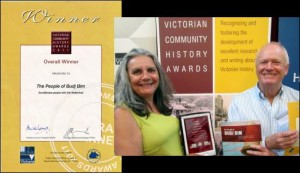
- 2011: Gunditjmara people with Gib Wettenhall for The People of Budj Bim
- 2010: Jenny Davies for Behind the Facade: Flinders Street more than just a Railway Station
- 2009: Ken Oldis for The Chinawoman
- 2008: Annette O’Donohue & Bev Hanson for Eaglehawk & District Pioneer Register Volume 6 – T-Z
- 2007: Jillian Durance for Still Going Strong: The story of the Moyarra Honor Roll
- 2005: Justin Corfield, Dorothy Wickham and Clare Gervasoni for The Eureka Encyclopaedia
- 2004: Wandiligong Preservation Society Co-ordinated by Coral Bennett and Joy Kit for Oriental Crossing
- 2003: Ann Synan for We Came With Nothing: Story of the West Sale Migrant Holding Centre
- 2002: Gillian Upton for The George: St Kilda Life and Times
- 2001: Warik Lawrance for 1864 (CD ROM)
- 2000: Daryl Tonkin and Carolyn Landon for Jackson’s Track – A Memoir of a Dreamtime Place
- 1999: Dr. Andrew Brown-May for Melbourne Street Life
- 1998: Patrick Morgan for The Settling of Gippsland, A Regional History
Best Community Research, Registers and Records
- 2011: Marie Hansen Fels for ‘I succeeded Once’: The Aboriginal Protectorate on the Mornington Peninsula, 1839-1840.
- 2010: Susie Zada and Pam Jennings for Scots in Geelong and District to 1860
- 2009: Karen T Collins, Collingwood Historical Society for Bitter Roots, Sweet Fruit: A history of schools in Collingwood, Abbotsford and Clifton Hill
- 2008: John McKay and Hamilton History Centre Inc for The Streets of Hamilton, Western Victoria Australia: a History of the People behind the Names
- 2007: Port Melbourne Historical & Preservation Society for History of a Street Precinct
- 2005: Graeme Massey for Gallipoli Heroes: A tribute to the men from Western Victoria who gave their lives for their country
- 2004: Arthur Yong, North Eastern Melbourne Chinese Association for Chinese Settlement in Darebin
- 2003: Graeme Massey (Warracknabeal Secondary College – History Department) for Fallen Heroes. Warracknabeal War Memorial
- 2002: Dianne Carroll for Carroll Heritage Collection
- 2001: Allan Willingham for Camperdown: A Heritage Study
- 2000: Keith Clarke for Convicts of the Port Phillip District
- 1999: Brendan Fitzgerald and Bayside Library Services for Sin on Disc
Best Collaborative / Community Work
- 2011: Michael Collins and others for Our Boys at the Front: The Mornington Peninsula at War 1914-18 from the pages of the Peninsula Post. (Book and DVD)
- 2010: Yarra Valley Italian Cultural Group for Dreams from a Suitcase (‘Sogni Dalla Valigia’): Recollections of Italian Settlers in the Yarra Valley
- 2009: Christine Grayden, Phillip Island Conservation Society for An Island Worth Conserving: A History of the Phillip Island Conservation Society
- 2008: Collingwood Historical Society Inc for Collingwood Plaques Project
- 2007: Andrew Brown-May and Shurlee Swain (ed) for The Encyclopedia of Melbourne
- 2005: Peter Yule (ed.) and the Carlton Residents Association Inc. for Carlton: A History
- 2004: Elizabeth Huf for Courage, Patience and Persistence: 150 Years of German Settlement in Western Victoria
- 2003: Jewish Museum of Australia (in association with Shalom Association) for From Russia with Hope: Australian Jews from Russia 1870-2002 (Exhibition)
- 2002: South Port Day Links and Port Melbourne Historical Society for Linking Us Together
- 2001: Sigrid Borke for In and Out of Port. Voices from the Port of Melbourne. An Oral History
- 2000: City of Whittlesea for Oral History and Poster Exhibition Project
- 1999: Jan Critchett for Untold Stories – Memories and Lives of Victorian Koories
- 1998: Linda Barraclough for historical research and community work in Gippsland
Best Print / Publication – Commercial
- 2011: Ron Hateley for The Victorian Bush: its ‘original and natural’ condition.
Best Print / Publication – Self or Community Publication
- 2011 Anne Longmire for The Catalysts: Change and Continuity 1910-2010.
Best Print / Publication
In 2011 the Best Print / Publication category was divided into Best Commercial Publication and Best Self or Community Publication. See above.
- 2010: Robin Grow for Melbourne Art Deco
- 2009: Gary Presland for The Place for a Village: How nature has shaped the City of Melbourne
- 2008: Barry Heard for The View from Connor’s Hill
- 2007: Richard Broome for Aboriginal Victorians: A History Since 1800
- 2005: Barry Hill and the Borough of Queenscliffe for The Enduring Rip: A History of Queenscliffe
- 2004: John Poynter for Mr Felton’s Bequests
- 2003: Vicki Fairfax for A Place Across the River. They Aspired to Create the Victorian Arts Centre
- 2002: Carolyn Rasmussen for A Museum for the People
- 2001: Adrian Jones for Follow the Gleam: A History of Essendon Primary School 1850-2000
- 2000: Peter Yule for The Royal Children’s Hospital A History of Faith, Science and Love
- 1999: Janet McCalman for Sex and Suffering – Women’s Health and a Women’s Hospital
- 1998: Phil Taylor for Karkarook: a Mallee Shire History
Best Walk / Tour
- 2011: Peter Cuffley, Helen McBurney, Geoff Palmer & Janey Runci for Henry Handel Richardson in Maldon.
- 2010: Karen McIntyre for Lake Bolac Heritage Walk
- 2009: Wangaratta Regional Tourist Development Inc for Heritage Walk, Wangaratta
- 2008: Bayside City Council for Bayside Architectural Trail
- 2007: Ruth Gallant, Footscray Reference Group & Maribyrnong City Council for Footscray Trail: a guided walk through the historic central business district
- 2005: Margaret Gardner and Val Heffernan, The Hamilton History Centre for Exploring Hamilton Walks
- 2004: Don Chambers for Melbourne General Cemetery
- 2003: Carmel Taig for Yarraville in 1901
- 2002: Ross Bastiaan for The Kokoda Walk in the Dandenong Ranges National Park
- 2001: Bayside City Council for Bayside Coastal Art Trail. Stage 3
- 2000: Richard Peterson for Brimstone to Bunyip Churches of Collingwood, Clifton Hill and Abbotsford 1852-1999
- 1999: Angela Taylor, Ron Hateley, Tarnya Kruger for The La Gerche Walking Track
- 1998: Mary Ryllis Clark for Discover Historic Victoria
Best Exhibit or Multimedia
- 2011: The Jewish Museum of Australia for Mameloshn: How Yiddish made a home in Melbourne.
Best Audio-Visual / Multimedia
In 2011 Best Exhibit and Best Audio-Visual / Multimedia were combined as a category. See above.
- 2010: Keith White & Will Twycross for Visions of Port Phillip: The Burrells of Arthur’s Seat 1851-1925
- 2009: Bendigo Chinese Association Museum Inc trading as Golden Dragon Museum for Creating a Community Museum
- 2008: Malcolm McKinnon and The Victorian Country Football League for Football Stories from Country Victoria
- 2007: Landsborough Festivals Inc for From Gold to Grapes: The Story of Landborough
- 2005: The Euston/Robinvale Historical Society Inc for Happy Birthday Robinvale
- 2004: James McCaughey, Red Finch Films for The First Eleven: The First Australian Cricket Tour of England (Video)
- 2003: Lakes Entrance Family History Resource Centre for Casting the Net – Pioneer Fishing Families of the Gippsland Coast
- 2002: Geoff Russell for Sir John Quick and Bendigo’s ANA
- 2001: Lilydale & District Historical Society for Melba – Australia’s Greatest Daughter
- 2000: Bronwyn Hughes (Author), Laki Sideris (Developer) and Tim Dolby (Producer) for Lights of our Past: Australian Stained Glass
- 1999: Timothy Lee for Wally’s Weddings/The Bush Smithy
Best Exhibit / Display
In 2011 Best Exhibit and Best Audio-Visual / Multimedia were combined as a category. See above.
- 2010: Janine Rizzetti (Heidelberg Historical Society) for An Invitation to the Ball
- 2009: Port Melbourne Historical and Preservation Society for The Navy in Port Exhibition: A month of celebration for the centenary of the Great White Fleet visit
- 2008: Robinvale Network House for Migration Memories – Robinvale
- 2007: Victorian Jazz Archive Inc. for Jazz Spans the Decades – A History of Jazz in Victoria
- 2005: David Williams for Harvests, Headlands & Halcyon Heritage
- 2004: Jointly organised by the Warrnambool Art Gallery and the Warrnambool and District Historical Vehicle Club. Curated by Brenda O’Connor for Early Motoring in Warrnambool
- 2003: Melbourne’s Living Museum of the West for A Stone Upon A Stone: A Touring Exhibition about the History and Heritage of Dry Stone Walls
- 2002: Laharum Hall Committee for Federation Mural: History of Laharum
- 2001: Golden Dragon Museum, Bendigo for Showing Face
- 2000: Tatura and District Australia Day 2000 Committee for Tatura Collage Columns
- 1999: Jan Mitchell for Baywalk Bollards Project
- 1998: Mr Russell Jack – Bendigo Golden Dragon Museum
Special awards
- 2011: Judges’ Special Prize for Excellence – Gregory Eccleston and others for Early Navigators of Bass Strait, 1770-1803. (Map)
- 2010: Award to Celebrate 175th Melbourne Anniversary – Bain Attwood for Possession: Batman’s Treaty and the matter of history
- 2009: Judges’ Special Prize for Excellence – Paul R Mullaly for Crime in the Port Phillip District 1835-51
Stories of the 2017 Victorian Community History Award Winners
Local project award: Collingwood Historical Society for Notable People of Collingwood
Profile of Notable People of Collingwood
Helping us make sense of our current environment
Paul Sandringham, April 2018
Mention “Collingwood” and most Australians, of course, will think of the love-’em-or-hate-’em football team and its supporters. Extend the expression to “notable people of Collingwood” and at best there might be a reference to great players or coaches from the past, perhaps a snide remark about a current TV personality.
But for some 8,500 people today, Collingwood means home. You can add Clifton Hill and Abbotsford to that, two adjacent suburbs that were part of the former City of Collingwood, and the population is around 20,000. Who, though are the notable people?
Most of us don’t know, of course.
Karen Cummings, a history graduate and librarian, didn’t know either. But then she bought a house in Clifton Hill, and started looking into its history. Fascination took root. Someone famous had once lived in Karen’s house – and had been involved with other historic figures, other people that Karen herself had never associated with Collingwood. Karen is the President of the Collingwood Historical Society. A project was born: the Notable People of Collingwood
Before talking to Karen, I thought I’d test the project database out. It’s all on the web which, as Karen explains, is the ideal vehicle for an ongoing project like this. More information can be added as it comes to hand, newly discovered links between notables can be inserted, and the list of notable people keeps on growing. So I browsed for Lou Richards. He was there, of course, but so, to my great surprise, was Tom Roberts. I was hooked. I discovered Billibellary, the Vale sisters and many others.
This is what it’s all about: the fascination of just who used to live in this inner suburb and what they brought to Melbourne, Australia and the world. Placing such diverse people in a geographical context, and in the context of their contemporaries from the area, extends their contribution to the present day as they help us make sense of the world in which we live.
There is potential for a lot more outreach with the project, of course, but that takes time and money. The web helps, however, because the site is extensively indexed and linked with national archive and biography services. The Collingwood Historical Society’s history walks refer participants to the database, too, and some people find the database by searching the web after seeing a Collingwood notable’s name on a plaque.
Contributors to the project do not all live locally, though. One key member, a Collingwood local, now lives on the Mornington Peninsula. There have been contributions from New Zealand, and there is a very active contributor living in England.
Winning the 2017 RHSV Local History Project award means “a little fame and fortune” for the core group, but more important is the recognition for their efforts. Perhaps, too, it will inspire another generation of local historians to become involved and make new local history projects possible, fulfilling Karen’s vision of local history: “helping us make sense of our current environment”.
Collaborative Community Award : Fletcher Jones : Stories from our Community
Profile of FJ Stories
Paul Sandringham, March 2018
Those of us who grew up in Australia and are older than, say, 35, will know the name Fletcher Jones from at least one skirt or pair of trousers. Chances are that for our first job interview or wedding, or maybe for the school formal, Mum took us shopping and bought us something decent, durable and worth the money — something with an FJ label.
If we grew up in Warrnambool, though, the name means more than just a label in a pair of slacks. Fletcher Jones and his clothing business were associated with the town from the 1920s on, and beginning in the 1940s, Fletcher Jones & Staff developed into Warrnambool’s largest employer — jointly owned by Jones himself and the people who worked there. The founder and company were also the city’s benefactors, and the company gardens served as a public park and hosted an annual Christmas party for staff and family. The factory’s water tower, the 40m-high Silver Ball, became a Warrnambool landmark.
As the 20th century drew to an end, however, FJ’s star waned, and the factory finally closed its doors in 2005. The State Heritage-listed buildings, Silver Ball and gardens began to decay.
In early 2014, a small, diverse group of local residents, united by a concerned awareness of what happens when a community loses sight of its heritage, began asking for stories and anecdotes about Fletcher Jones, the man and the company, on a Facebook page. The response was strong and a project took shape. The developing community network also gave a voice to concerns about the future of the gardens, the Silver Ball and the factory site. This resonated with an entrepreneur from the region, who acquired the site, and in the spirit of Fletcher Jones has been working with the community to preserve the FJ heritage ever since. The gardens, although private property, are once again open to the public, and the traditional Christmas party was revived as a community event from 2014. A Jones family reunion in Warrnambool at Christmas 2015 marked the start of ongoing support for the project from the descendants of Sir Fletcher.
All of the buildings at the FJ site are set to be maintained and repurposed by the new owner. A parallel campaign to rescue the Silver Ball, with strands as diverse as a film festival and a primary school project, united the community across social strata and generations. The stories and anecdotes about Fletcher Jones, and the cooperative business he founded, are recorded on a dedicated website and on two large story panels newly installed at the factory site.
The volunteer project, Fletcher Jones: Stories from Our Community, won the 2017 RHSV Collaborative Community History Award. A pupil of East Warrnambool Primary School said of the Silver Ball that it helps her find her way home. With the award bringing FJ Stories to a wider and more lasting audience, project coordinator Julie Eagles hopes that other communities, too, will be inspired to preserve their heritage, helping present and future generations find their way home.
 239 A'Beckett Street Melbourne, Victoria, 3000
  03 9326 9288
  office@historyvictoria.org.au
  Office & Library: Weekdays 10am-4pm

